
Innovation and advocacy: Building the early childhood workforce
If implemented, the many innovative solutions for building the early childhood workforce could have phenomenal results.

Many Michigan parents are unable to work because they do not have access to child care. This was one finding of “Untapped Potential: Michigan,” a 2023 U.S. Chamber of Commerce Foundation (USCCF) report. Based on survey data gathered from 501 Michigan parents of children under six, the report concluded that being unable to find or afford child care not only drives parents out of the workforce but also reduces state tax revenue by $576 million annually, and strains Michigan households, especially those with low incomes. In addition, child care issues cost Michigan’s economy an estimated $2.88 billion each year. Child care-related absenteeism and turnover costs Michigan employers another $2.3 billion annually.
The shortage of child care workers is the root of Michigan’s child care crisis. Across Michigan, about four children contend for every available child care spot, with child care deserts most concentrated in rural and northern regions.

“About half of kids in Michigan live in what are considered child care deserts –– a zip code that either has no slots available or three or more kids per slot. An additional 40% of kids live in a zip code that has an insufficient number of slots, meaning two kids per slot,” says Anne Kuhnen, Kids Count policy director at the Michigan League for Public Policy (MLPP).
Kuhnen cites another report, Confronting Michigan’s early childhood workforce crisis, that MLPP collaborated on with Think Babies in 2022.
“In Michigan, two in three children birth to five have all of their available parents working,” Kuhnen says. “This is almost half a million kids under the age of six. We have fewer than 400,000 licensed slots in Michigan for ages birth to 12.”
Because urban areas like Wayne, Oakland, and Ingham counties rely on the immigrant workforce in the early childhood sector, current federal immigration policies are creating another barrier to care.
“Immigrant women make up a large number of child care workers in Michigan. About 7% of the workers are immigrants,” Kuhnen says. “The shortage might continue to worsen as the federal government continues its attacks on immigrant workers.”

Low wages a root cause
Low wages are the main reason it’s difficult to recruit and retain a healthy child care workforce in all parts of the state –– and impact quality of care.
“Low wages and high staff turnover also certainly affect the quality of care,” Kuhnen says. “Michigan does have a quality rating system, but about half of providers don’t participate in this system. Higher reimbursement rates are available [for participating providers], but research suggests that the reimbursement rates don’t fully account for the added costs of increasing quality.”
Kuhnen notes that early care educators would earn three times their wages if they were working in an elementary or middle school classroom. The Center for the Study of Child Care Employment found that 12% of Michigan’s early care and education workforce lives in poverty.
“That’s very high for a group of people who are working in essential jobs that the rest of our economy relies on,” Kuhnen says. “About 40% are participating in some sort of public safety net program –– Medicaid and SNAP, programs that are under attack right now in our federal budget. So, it’s certainly not a very compelling career path.”
Developing solutions
One solution is to reduce administrative costs for child care providers and early education centers. Child Care Back Office is a managed service organization (MSO). MSOs provide administrative, operational, and financial management services. Child Care Back Office supports Michigan’s child care centers with services such as hiring, enrollment, accounting, licensing and compliance, crisis management, ordering supplies, and meeting USDA guidelines in menu planning.
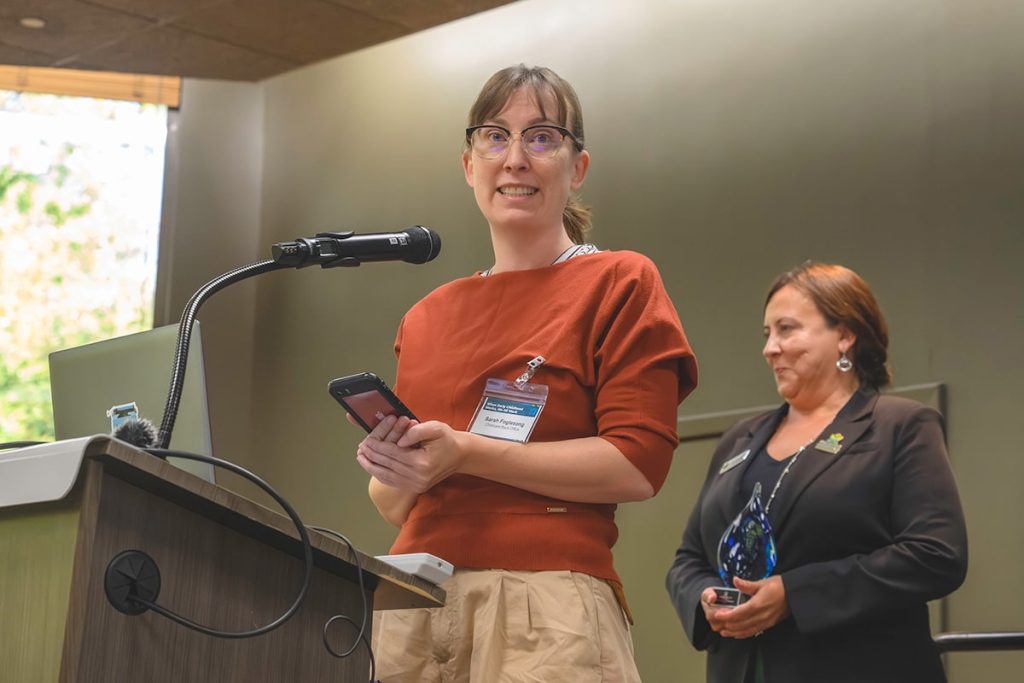
“It’s a pretty wide array of administrative tasks that child care providers are expected to complete,” says Sarah Fogelsong, CEO, Child Care Back Office. “They’re covering both those basic business functions as well as the child care-specific functions for administration.”
Foglesong says that time spent on administration undermines efficiencies that could reduce costs, making more funds available for staff compensation. Better wages would both attract more people to the field and keep them there.
“It causes a lot of burnout when they’re doing a more than full-time job on top of their full-time job of caring for children, especially if they’re a home-based provider,” she says. “That’s stress that can cause an otherwise passionate educator to leave the field.”
Child Care Back Office recently launched pilots in northeast and southeast Michigan. Participating child care centers receive help with staff recruitment and retention, operations, and licensing compliance.
“That licensing compliance piece helps providers streamline daily tasks, tackle the paperwork and documents that go into maintaining licensure, and risk management –– putting systems into place that streamline the documentation of incidents,” Foglesong says.
A new southwest Michigan pilot will provide child care providers with additional coaching and consulting around topics like business taxes, licensing, compliance, and other paperwork.
“Everyone across the state is struggling with paperwork and administrative tasks. But each region has its own flavor,” Fogelsong says. “As we’re launching these various pilots in different regions, we’re looking at what they need first.”
Child Care Back Office also supports another solution, the MI Tri-Share Child Care Program. Tri-Share splits the cost of child care among participating employers, employees, and the State of Michigan. Tri-Share is one more way to make high-quality child care more affordable for families, help businesses retain workers, and ensure stability for licensed child care providers.

Building the pipeline
Another solution is to build interest in early childhood careers among students starting in middle school. The Michigan Educator Workforce Initiative (MEWI) collaborates with middle schools, high schools, colleges, and universities to expose students to careers in education.
MEWI’s founder and CEO Jack Elsey asks, “How do we inspire high schoolers or middle schoolers to want to become teachers? How do we get more people as they’re enrolling in college or after college to become teachers? And how do we make the teaching role a really exciting, sustainable, relevant one that will entice our best?”
MEWI has launched 11 programs to help build that career pipeline. Specific to early childhood, My Early Apprentice supports people already working with schools by providing resource navigation, full funding, and wraparound support as they seek a child development associate (CDA) credential or associate’s or bachelor’s degree in early education. More than 90% of people completing the program have remained in the early education profession.
“There’s a real opportunity in investing in those folks who are already committed to serving our kids in roles like substitutes, paraprofessionals, or bus drivers –– folks who have been living in our communities, have been supporting our students, but have faced a financial or other barrier that has kept them from accessing higher ed,” Elsey says.

Pictured: Teacher and children at The Boston Square Early Childhood Center in Grand Rapids.
The program also ensures that children in early education programs have skilled teachers who are dedicated to high-quality early learning.
“This has become one of the largest teacher apprenticeship programs in the country in its first couple years in operation,” Elsy says. “The program shows that it’s not that people don’t want to become teachers.”
Elsey also emphasizes the need to increase funding for early education and increase salaries for early education professionals.
“There is a bigger, healthier conversation to have around our vision for early childhood statewide,” Elsey says. “How do we think it ought to be funded? What should access look like for communities all across the state? There are lots of really great folks in the space who are having that conversation. We have more to do there as a state.”
On average in 2023, Michigan’s child care providers earned 61% of the typical Michigander’s wage, and preschool teachers earned 78%, of the average Michigander’s wage.
Another part of the solution is changing the narrative around the value of caring for children, whether that care is provided by professionals or parents or relatives in the home. That solution could mean paid parental leave on par with other developed countries as well as a competitive wage for child care professionals.
“When thinking about why pay is so low in this sector, we’re recognizing that, historically, we’ve relied on unpaid or very low paid labor, mostly from women of color, to do this work for free or not at a competitive, livable wage,” says Kuhnen. “The way that our pay system is not working right now is very embedded in our history with child care in this country.”
Photos by Tommy Allen, John Grap, Doug Coombe, and Nick Hagen.
Anne Kuhnen photo courtesy Michigan League for Public Policy.
Early Education Matters shares how Michigan parents, child care providers, and early childhood educators are working together to create more early education opportunities for all little Michiganders. It is made possible with funding from the W.K. Kellogg Foundation.
Author

Related Articles

Innovation and advocacy: Building the early childhood workforce
If implemented, the many innovative solutions for building the early childhood workforce could have phenomenal results.